As of 2025, over half of eligible beneficiaries are enrolled in a Medicare Advantage (MA) plan, according to a new KFF report.
As MA penetration has increased, home health providers have struggled to grow or even maintain their operations, and MA growth is expected to continue.
Enrollment in MA plans influences federal spending because Medicare payments to private plans surpass those for similar beneficiaries in traditional Medicare, according to the Medicare Payment Advisory Commission (MedPAC).
In 2025, per-person payments will rise by 20%, adding $84 billion to federal expenditures. This is a significant increase from the $18 billion spent in 2015, when about one-third of eligible beneficiaries participated in MA plans, according to the report.
Considering the enrollment and spending trends, lawmakers are focusing more on how Medicare compensates private plans, although there is still no consensus on the approach or timeline for changes. Part of the challenge stems from concerns about how payment adjustments could affect beneficiaries’ ability to choose plans and access supplemental benefits like dental, vision and hearing coverage.
The proportion of eligible Medicare recipients enrolled in MA plans has skyrocketed from 19% in 2007 to 54% in 2025. The Congressional Budget Office (CBO) projects that by 2034, 64% of all Medicare beneficiaries will be enrolled in MA plans.
KFF reported that 62% of MA enrollees are in plans generally accessible to all beneficiaries for individual enrollment. While the proportion of individual plans remains stable in overall MA enrollment this year compared to last, their share has decreased since 2010, when they accounted for 71% of all enrollees. This decline is attributed to faster growth in special needs plans, now totaling nearly 7.3 million Medicare beneficiaries.
Of these 7.3 million people, over 80% are enrolled in plans designed for individuals eligible for both Medicare and Medicaid. However, plans targeting people with specific chronic conditions grew by more than 70% between 2024 and 2025.
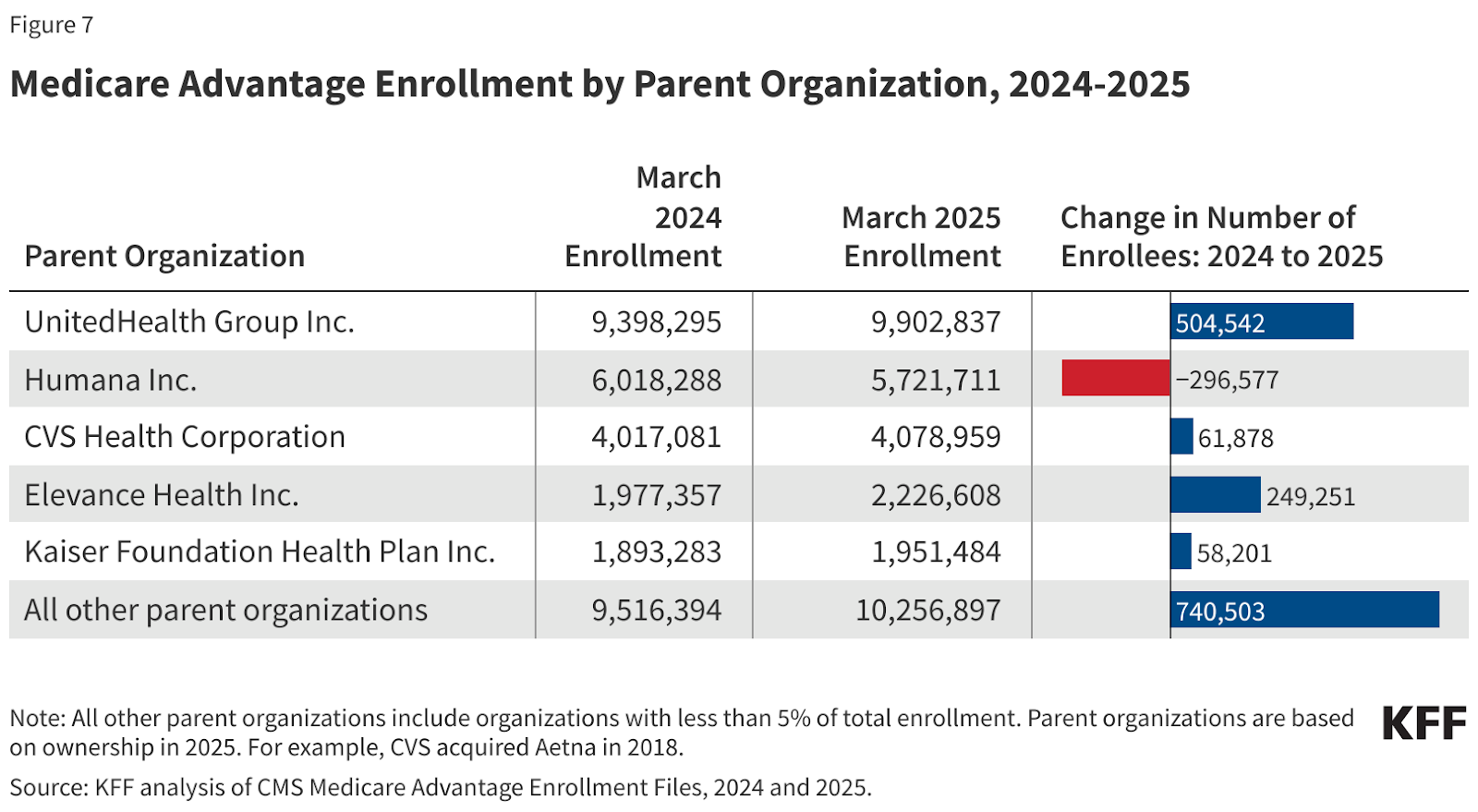
Furthermore, MA enrollment is concentrated among plans run by a few parent organizations, according to the report. UnitedHealth Group (NYSE: UNH) and Humana (NYSE: HUM) account for 46% of all MA enrollees nationwide. UHG is the largest provider and gained nearly 505,000 enrollees in 2025, while Elevance Health (NYSE: ELV) increased by about 250,000. In contrast, Humana enrollment decreased by approximately 297,000 between 2024 and 2025.
Companies featured in this article:
Congressional Budget Office, Elevance Health, Humana, KFF, Medicare Payment Advisory Commission, UnitedHealth Group