

This article is a part of your HHCN+ Membership
Team Select Home Care bet $6 million on an unproven concept: that proprietary predictive AI, trained on more than a decade of patient records, could catch subtle clinical decline and keep medically fragile patients out of the hospital. Now, the provider is reporting measurable results — and using them to reshape how it negotiates with payers.
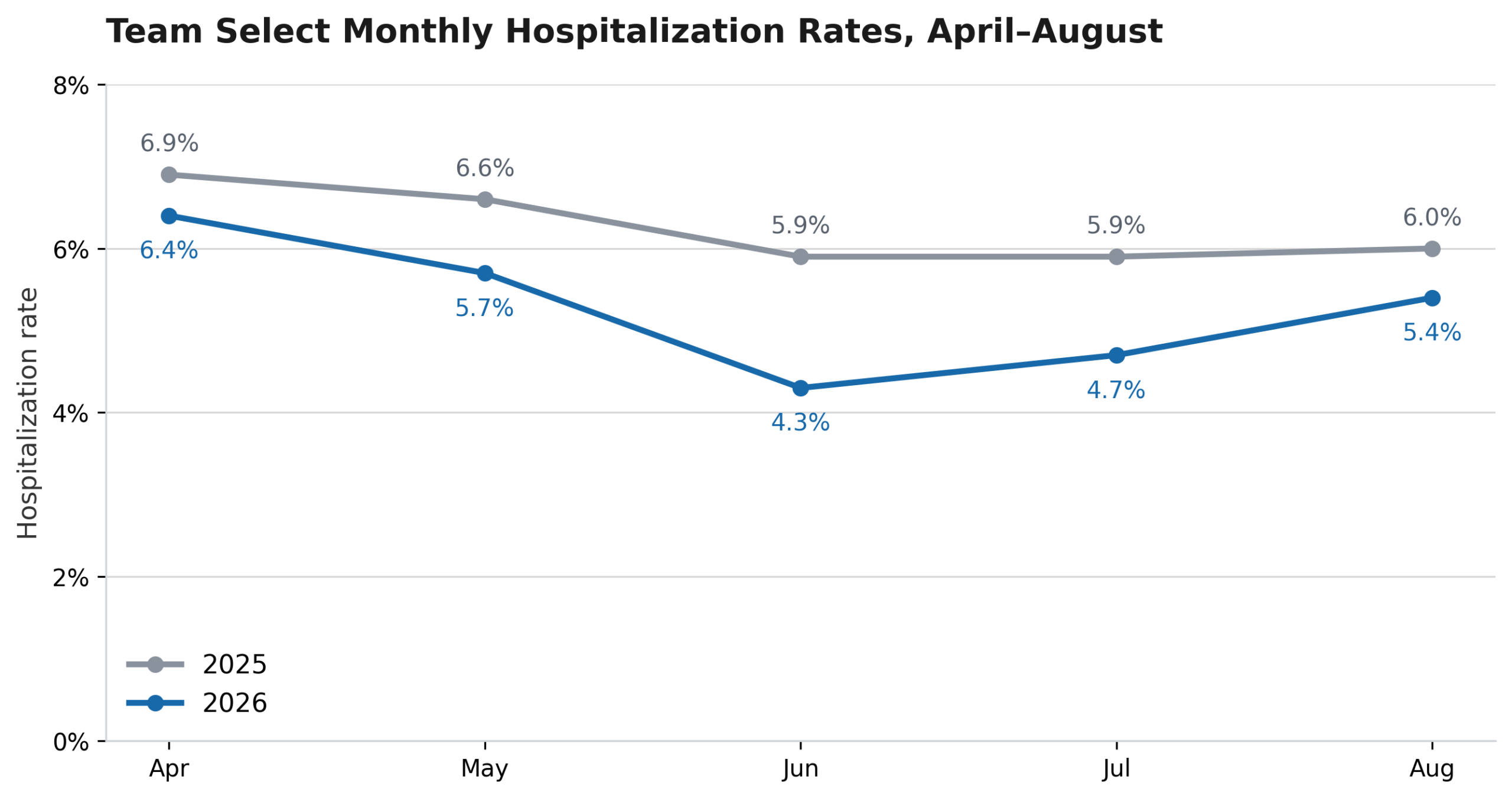
With the machine learning platform, called CareSight AI, now expanded to cover 100% of its patient census, Team Select is betting that its hospital-avoidance data can unlock additional value-based contracts. Between April and August 2026, hospitalization rates among Team Select’s patients dropped 14.9% year over year, according to company data shared with Home Health Care News.
“I knew that if we could do this, not only would it be a long-lasting competitive advantage … [it] would significantly decrease those hospitalizations even further,” President and CEO Fred Johnson said. “It just makes the world a better place.”
Phoenix-based Team Select Home Care serves the medically complex pediatric population and seniors in the home, operating in 16 states. Private equity firm Court Square Capital Partners invested in the company in 2023.
Team Select launched CareSight in 2025, using over a decade’s worth of Team Select patient data. The tool monitors up to eight vital signs in real time, along with nurse notes and changes in condition. The technology can flag subtle trends that clinicians might otherwise miss, Johnson said.
The company first launched the tool specifically for respiratory patients. The initial model could not cover all diagnoses, Johnson said, so the company evaluated which disease types or comorbidities accounted for the most hospitalizations to identify a starting point. Leadership chose respiratory patients because Team Select excels at high-acuity care, the CEO said.
Expanding CareSight
The technology caused hospitalization rates for those patients to plummet, he said, so Team Select turned to cardiac patients. While the respiratory model required three years to develop, the cardiac-specific platform required only six months, because the company had already cleansed its backlog of data and learned from CareSight’s first iteration.
With the cardiac model, 65% of Team Select’s patients were covered by one of the two CareSight models. To expand that number, Team Select launched an infection detection model. The company’s data showed that infections were a significant source of unnecessary hospitalizations, so Team Select developed a model to address that risk. This development period required only 90 days, Johnson said.
Now, 100% of the company’s patients are covered by at least one of the three models.
Developing the platform also changed how Team Select approached alerts. At first, the technology was overly cautious, Johnson said, and generated too many false positives. For instance, the technology would flag that a patient’s respiratory rate was outside standard parameters, even if that reading was normal for that specific patient. Adding a second, patient-specific model allowed the platform to check alerts against each patient’s historical baseline, reducing false positives, which could burden clinicians with unnecessary alerts.
Data to back up the technology
Johnson shared five months’ worth of outcome data with HHCN, comparing April through August 2026 with the same period in 2025.
With the three CareSight platforms now in place, Team Select’s hospitalization rate has dropped 14.9% year over year. That improvement builds on what Johnson said was already a low hospitalization rate compared to the industry average.
Prior to launching CareSight, a seven-state Medicaid claims study commissioned by Team Select found that its monthly 30-day hospitalization rate was 3% to 8%, he said, compared to an industry average of 10% to 20% per month.
The technology keeps children safe at home and out of the hospital, Johnson said, but also serves as a competitive differentiator.
“The reality is that most of our competitors aren’t on one EMR,” the CEO said. “They don’t always integrate all of their acquisitions, and they don’t have a data strategy that goes back more than a decade, as we did. So I saw the opportunity and the worth of the risk to take because I’m pretty confident that none of our competitors could copy this anytime soon.”
The technology is changing how the provider works with payers, too. Over time, with CareSight on board, Team Select expects to win more contracts and continue expanding its value-based contracting, Johnson said.
This is especially essential when fee-for-service rate increases are harder to come by, he said.
“When a payer says, ‘We got budget problems, I don’t have any money to give you a rate increase,’ we can say, ‘Fine. We’ll earn it. We will put our money where our mouth is, and we will do a value-based contract where the only way we can get a rate increase for more money is by delivering on hospitalization reduction and total cost of care reduction.'”
The company is also redeveloping payer scorecards, which would allow payers to see Net Promoter Scores, hospitalization and emergency department visit ratios for their specific patients, and compare that data to the industry average.
“All those things can create a stronger company and a stronger marketplace,” he said. “In a marketplace where the companies that are driving the necessary outcomes are rewarded, I view this tool as a long-term way to increase the bar in this industry.”
Team Select is not stopping its expansion of CareSight. The company is currently building its fourth model, focused on diabetic patients. Moving forward, Team Select will continue targeting body systems or comorbidities in descending order of cost of care and frequency of hospitalization.
Moving forward, Team Select will continue targeting the body systems or comorbidities associated with the highest costs of care and the most frequent hospitalizations.
By continually expanding CareSight, Team Select plans to keep investing in a tool that Johnson said improves as it processes more data, while focusing on the patients with the highest costs of care for payers.
Companies featured in this article: