
This article is a part of your HHCN+ Membership
As the center of health care has increasingly moved into the home, home-based care services have become more complex.
Home-based care providers shared the ways that their strategies, challenges and opportunities are evolving amid this growing complexity at HHCN’s FUTURE conference in Austin. In an HHCN+ Update I wrote at the event, I shared a few initial takeaways. Now that some time has passed, I’ve reflected on the conversations, and two takeaways have stuck with me.
First, home-based care providers are being asked to take on higher acuity patients and more complex, longer-term responsibilities, including limiting readmissions. And yet, reimbursement remains episodic, and enrollment restrictions and network consolidation can limit providers’ ability to expand into underserved markets.
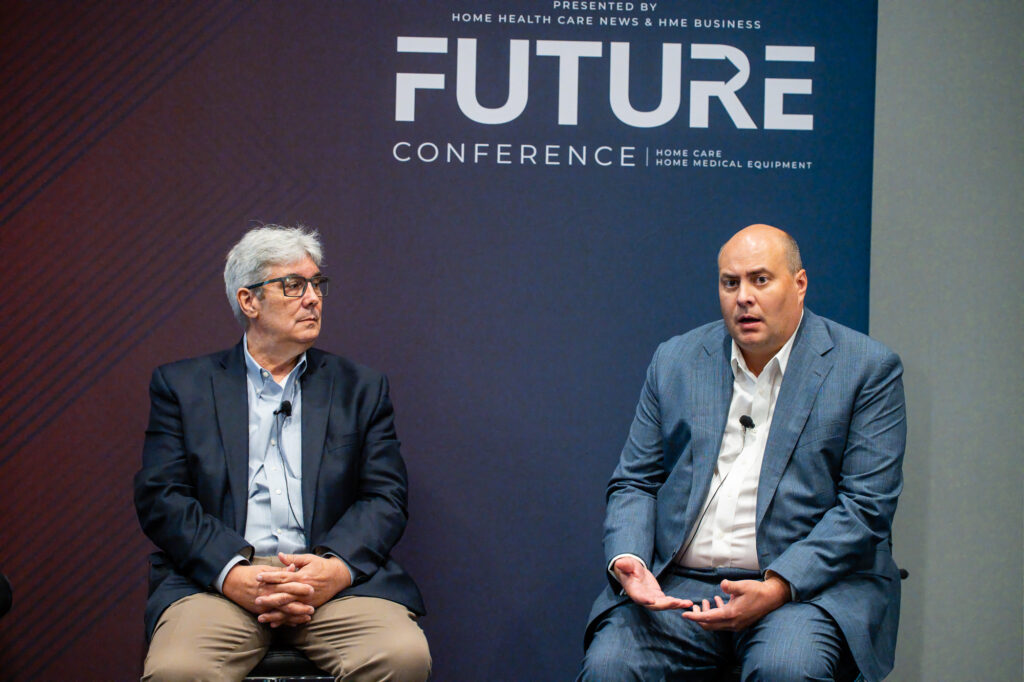
“We’re seeing a progressive interest in readmissions, and although we’re not always inherently incentivized, we’re being asked to go upstream and do more,” Casey McKeon, President of CenterWell Home Solutions, said on a panel at FUTURE.
Second, technology is becoming a growth tool when it speeds up intake. If a provider cannot quickly receive, evaluate and accept a referral, hospitals and health systems will send the patient somewhere else.
In this week’s exclusive, members-only HHCN+ Update, I’ll share key insights from HHCN’s FUTURE conference, offering analysis and key takeaways, including:
— The widening gap between rising clinical complexity and static reimbursement
— Why speed to referral acceptance has become a critical competitive differentiator
Meeting a rising complexity tide
At FUTURE, I repeatedly heard the same diagnosis from skilled home health and non-medical home care: patients are coming into the home with higher acuity levels. Each side is absorbing that shift differently — and the economics have not necessarily caught up with this trend.
McKeon said that health plans want home health partners to think beyond a traditional episode.
“We’re not thinking 30, 60 days; we’re thinking 180 days,” McKeon said. “And more importantly, we know that’s beyond in some cases when you’re recertified for care.”
Home health providers are then left to determine how to transition the patient to a primary care or other partner so that the patient does not readmit to the hospital. The key to providing more longitudinal care, McKeon said, is achieving sufficient reimbursement. Current reimbursement models do not allow providers to go upstream sufficiently, and other players are filling that gap by taking full financial risk on at-risk patients.
Providers that can care for higher acuity patients are grouped in with providers who care for more straightforward cases, Dean Alverson, President and CEO of LifeCare Home Health Family, said. From his view, providers should work to achieve rates that support that type of complex care.
“Make sure you price [higher acuity care] appropriately because at the end of the day, better care costs more money,” Alverson said. “We should stop undermining our own efforts there to have good profitability and good returns, so that we can reinvest in better quality care.”
In personal home care, rising acuity is also a growing challenge.
Dan Deak, the CEO of Home Halo, tied this to the rising cost of delivering care.
“You’ve seen caregiver wages increase dramatically, and with that, billable hour rates for clients have increased,” Deak said. “When I started the business, we were charging in the low $20s an hour. Now we’re paying caregivers that. So it’s becoming less affordable for private pay clients, and so they’re waiting longer. The acuity level is high.”
For Deak, one way to deal with increased acuity is through technology that shows the company what is happening in the home when caregivers are not there.
That same trend requires providers to decide, by design, who gets more attention, Tammy Tenton, vice president of clinical and compliance at Avid Health at Home, said.
“Rising acuity doesn’t necessarily mean asking staff to do more of the same,” Tenton said. “It means the sickest clients get measurably more attention by design, and certainly not by whoever happens to notice.”
What I took away: home health is being asked to manage risk over a longer horizon than it is paid for. Personal care is receiving clients later in decline. Both are meeting complexity with better targeting and better information — but neither has a payment model that fully matches the work.
Tech supporting speed
FUTURE is all about innovation in the home-based care space, so it’s no surprise that I typically walk away with some thoughts on technology. Providers are leaning on refreshed tech stacks to overhaul their businesses and cope with rapidly changing expectations from payers.
What stood out to me in the technology conversation was its role in hastening intake. Complications in the intake process can be a growth problem: If a provider cannot quickly receive, evaluate and accept a referral, hospitals and health systems will send the patient somewhere else.
“You’ve got to be able to accept a patient, especially from an acute care setting, within probably seven to 10 minutes,” Alverson said. “You’ve got to guarantee that you’re going to see that patient, if not the same day, within 24 hours.”
To keep those referral relationships, Alverson also emphasized the importance of providing referral partners with data, rather than relying on their data, which could be outdated.
Speed also allows providers to stand out in their markets. McKeon said that speed into the home is one of CenterWell Home Solutions’ differentiators. In cases when the provider cannot accept a patient quickly, referral partners opt for a different provider, he said, prompting CenterWell to rethink its intake process.
The need for speed is what drove Compassus to overhaul its intake process, using technology to dramatically slash intake time.
Chas Morgenstern, senior vice president of shared services and optimization at Compassus, outlined exactly how Compassus determined that intake had the right mix of “possible to get done” and “worth the payoff” to make a significant investment in new technology. Morgenstern said the company solved the “referral to referral acceptance journey.” Incoming referrals now run through business logic that checks whether Compassus can support a discipline in a given ZIP code and whether the patient is eligible.
What I took away: technology is becoming part of the growth engine when it protects speed, access and follow-through. Referral partners are not waiting for a provider to catch up. The agencies investing in intake, eligibility and scheduling infrastructure are not chasing novelty. They are trying to stay in the conversation when a hospital has a patient who needs to go home today.
Companies featured in this article:
CenterWell Home Solutions, Compassus, Home Halo, LifeCare Home Health Family