States are going beyond federal requirements to detect fraud in Medicaid home care, cross-checking billed services against electronic visit verifications (EVVs) and analyzing claims for specific patterns, according to a new KFF report.
Most states report that program integrity was one of their top three priorities, but the report’s authors cautioned that additional anti-fraud efforts could create hurdles that limit care access.
“While additional scrutiny and oversight may limit fraudulent or inappropriate Medicaid spending, additional efforts to combat fraud can create new administrative burdens and limit provider participation, potentially reducing access to care,” the authors wrote in an Oct. 5 report.
San Francisco-based KFF is a nonpartisan, nonprofit health policy research organization.
KFF surveyed officials administering Medicaid home care programs in all 50 states and D.C. between April and August 2026. Florida and South Carolina did not respond, and Minnesota did not answer a question related to program integrity.
Forty-two states reported using eight fraud oversight strategies included in KFF’s survey, including maintaining EVV data in machine-readable files and cross-checking billed claims against EVV data.
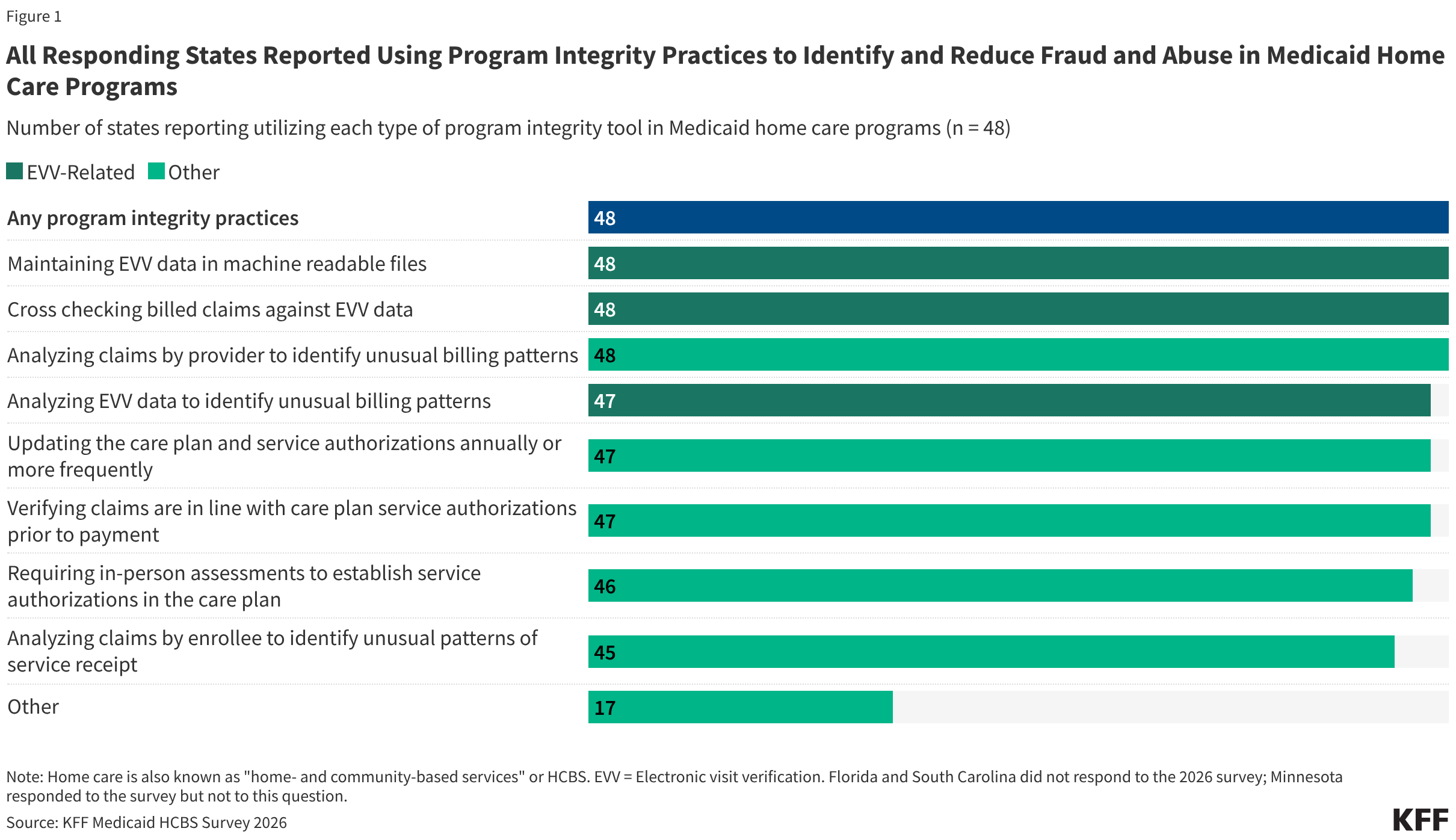 KFF
KFFThe 21st Century Cures Act of 2016 required states to use EVV for personal care services and home health services delivered in-home. EVV technology automates the timekeeping, attendance, care plans and other information that a home care worker inputs at the point of care to reduce in-home care fraud, according to Georgia Medicaid.
All responding states reported using at least one program integrity strategy beyond federal requirements, in addition to EVV. For instance, all surveyed states reported that they maintain EVV data in machine-readable files and cross-check billed claims against EVV data.
States are also using or exploring AI to detect potential fraud. Twenty-one of the 48 responding states said they were using AI, piloting it or planned to use it in their program integrity and data monitoring tools. The states currently using AI include Washington, Montana, Nevada, Arizona, New Mexico, Texas, Missouri, Arkansas, Indiana, Michigan, North Carolina and Connecticut.
States have increasingly cracked down on Medicaid home care fraud through a variety of measures, including imposing moratoria on new Medicaid provider enrollment and suspending providers. The Centers for Medicare & Medicaid Services (CMS) specifically recommended that states’ Medicaid programs consider their moratoria on Medicaid provider enrollment in documentation regarding the national moratorium on new Medicare home health enrollments.
Companies featured in this article: