Addus HomeCare Corporation (Nasdaq: ADUS) reported a decline in personal care census in the third quarter, weeks after agreeing to acquire personal care service (PCS) assets from AccentCare.
Addus is rolling out its caregiver app in more states to help it serve more authorized hours, while being selective about the cases it can staff effectively, CEO Dirk Allison said during the company’s Q3 earnings call on Wednesday.
“The slight decline in our personal care census over the prior year has primarily been in our lower hour cases, as our higher hour cases have increased year over year,” Allison said on the call. “This, along with the continued improvement in our service percentage, has contributed to our year-over-year increase in same-store personal care hours.”
Frisco, Texas-based Addus HomeCare provides home care, home health and hospice services. The company serves about 62,500 individuals throughout 263 locations within 24 states.
Allison attributed the decline in personal home care census to caregivers’ increasing desire for a 40-hour work week. Caring for clients who require few hours therefore becomes increasingly difficult to staff, he said.
Addus has two strategies to address this issue, Allison said. The first is the company’s technology, particularly its caregiver app Addus Connect. The app allows caregivers to access their schedule, modify their work hours and availability and view patient information.
Allison said the app performed well in Illinois. The company is currently rolling it out in Texas and plans to do so in New Mexico next.
“We should continue to see some positive improvements in in that metric, allowing us to serve more of the authorized hours that have been granted by the state,” Allison said.
The second strategy to increase census is to heighten selectivity. Allison said the company aims to be cautious when accepting patients to ensure they are a fit.
“What we’re trying to do is make sure we’re looking at the patients that give us more hours,” Allison said. “We’re trying to balance that with our referral sources to make sure that we’re doing all things that are necessary.”
However, Allison emphasized that Addus will still serve lower-hour patients. The company is looking to optimize its methodology to staff such patients most effectively with the hours that caregivers are looking for. That strategy has been a focus for the company for the past several quarters, Allison said.
Broader growth
On Sept. 14, Addus agreed to acquire AccentCare’s personal care assets, which spanned 10 states and served 13,700 clients in an average daily census, for about $275 million. Expected to close in Q1 2027, the deal would help Addus enter Colorado, Georgia, Minnesota, Pennsylvania, Tennessee and Washington. Allison estimated that the deal would increase Addus’ revenue base by approximately 19%.
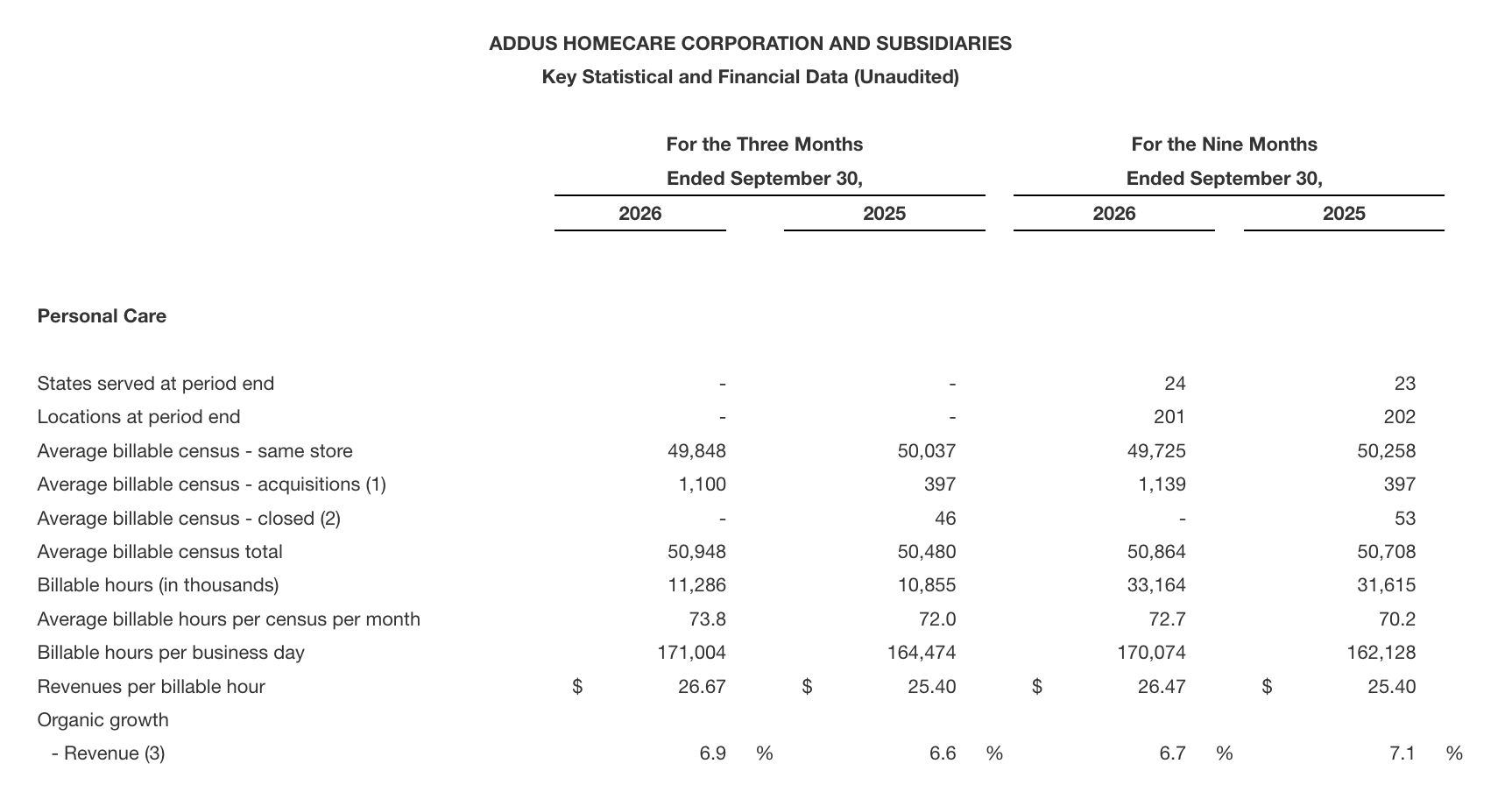
The company’s PCS unit brought in $301 million in revenue in Q3, a 9% year-over-year increase.
Across its entire business,Addus reported third-quarter net revenue of $387.7 million, a 7% increase year-over-year. Its adjusted EBITDA rang in at $51.2 million, a 13.5% year-over-year increase.
Addus’ smallest segment is its home health service line, which comprised 4.6% of the revenue in Q3. Home health brought in $17.7 million for the quarter, a 0.36% increase year-over-year. Home health same-store revenue increased 2.5% and same-store admissions rise 13.8% year-over-year, Allison said.
Q3 2026 is the first positive year-over-year revenue quarter for Addus’ home health segment in years, driven by the company’s new leadership team, Allison added.
Allison also said that the Medicare home health enrollment moratorium has not affected the company’s growth strategy.
“Obviously, just like in PCS, we are not a de novo-based business, so most of the moratoriums that are out there do not really affect our growth profile or how we operate,” Allison said. “As long as we can continue to look at certain acquisitions in the state, and as if they’re not covered by the moratorium, then we should be fine.”
Moving forward, the company plans to grow its home health arm as opportunities arise.
“We are not a home health company per se today,” Allison said. “We are a company that has a segment of home health, and we want to continue to grow that appropriately as we have opportunities.”
Companies featured in this article: