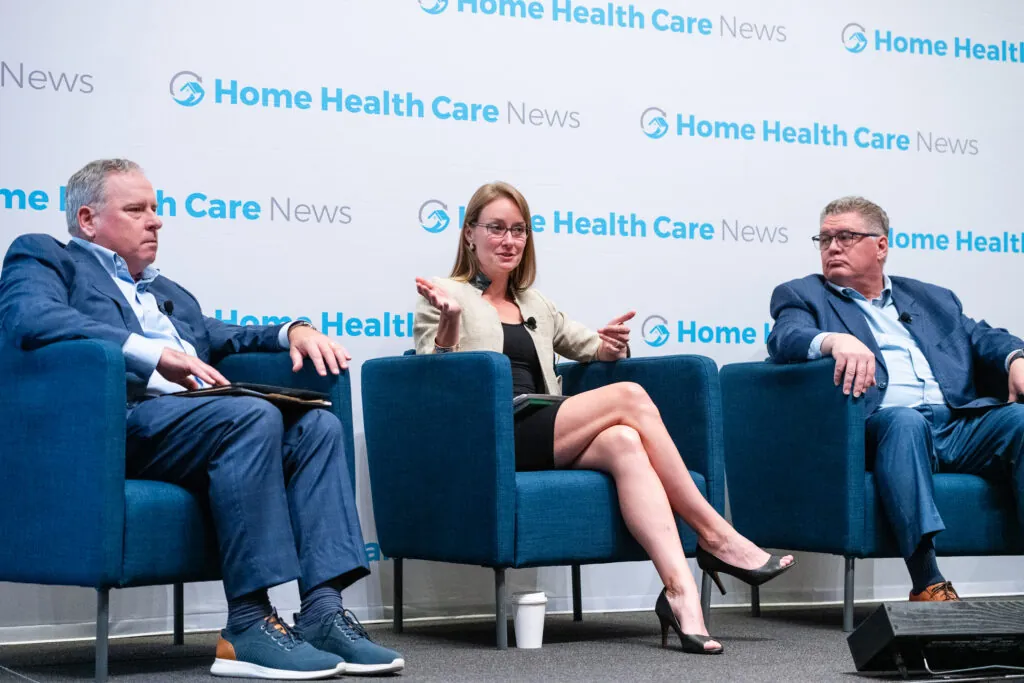
Only a handful of companies have earned the payvider moniker — operating as both payers and health care providers. However, organizations that operate under this hybrid business model are seeing unique strategic advantages, especially on the home-based care front.
Companies like Humana Inc. (NYSE: HUM) and VNS Health illustrate this growing trend, which is still relatively novel in the health care ecosystem.
“Looking back at, potentially, its origin, we could reference Kaiser, the predominant example of an early innovator, bringing together two really strong arms in both the payer and the provider side,” Dr. Laura Lawson, vice president of client solutions at research and advisory firm ATI Advisory, said on a panel at Home Health Care News’ FUTURE Conference. “Since Kaiser, we have seen other health systems pick up the capability, namely large and academic ones, and that’s been an increasing trend over the last decade or two.”
Aside from health systems, Lawson explained that payers have also thrown their weight behind building out provider arms.
“Looking at the payer side, there’s also been investment in building out the provider capability that has looked to be predominantly in primary care, as well as home-based care,” she said.
Kirk Allen, president of Humana Home Solutions, cites improved incentive alignment as one of the biggest advantages of operating as a payvider.
“You have the potential of a much better experience for the patient or member who’s receiving care,” he said during the panel. “I think you also have the opportunity to take advantage of plan design, meaning your providers and your payer know what is in the plan design, and can even alter it to benefit the population that you’re serving, because you’ve got that closed loop of information to say, ‘this is what we’re seeing in the home.’”
Humana is one of the largest insurers in the country, with more than five million Medicare Advantage (MA) members in its health plans. CenterWell is Humana’s provider services arm, which includes home health, pharmacy and primary care. The company performs over 9 million home health visits annually.
VNS Health also has a health plan business, which is exclusively focused on government programs, Medicare and Medicaid, with an orientation towards complex populations, low-income populations and individuals with special needs. Currently, the health plan has over 70,000 members.
“We’re set up as distinct businesses,” John Burke, executive vice president and chief of health plans at VNS Health, said during the discussion. “The health plan will contract with the provider side for the range of services they provide. In most instances, they’re the lead provider for those services, for skilled nursing in that example. Additionally, we share services at a corporate level, so both the plan and the provider get services, IT, legal, government affairs and some finance, from a shared part of the enterprise.”
VNS Health is one of the largest nonprofit home and community-based health care organizations in the country. The New York-based company is a full-service home-based care organization. On any given day, the company has over 73,000 patients, members and clients in its care.
Payvider benefits, challenges
Over the years, providers have sometimes encountered health plans that don’t have a strong understanding of home-based care. Burke believes that VNS Health’s position as a hybrid company has given it an advantage in this respect.
“There’s a deep understanding by the health plan of home and community-based services, because we have this legacy and large business that provides many of those services,” he said. “As a health plan, our orientation is Medicare Advantage and integrated care with our [managed long-term care] program, so essentially, frail, low-income elderly. How better to know that population than to have skilled and unskilled home care entities that are very active in those spaces.”
VNS Health has also experienced a quality and cost advantage as a result of its business model. This means timely home-based admissions, as well as lower hospital readmissions, Burke noted.
“There’s a lot of talking over the last couple of days about rate cuts,” Burke said. “Big plans tend to squeeze small providers, and we see this as a quality and cost-saving opportunity to have really high-quality home care, because we understand that side of the business, and I’d much rather lower my readmission rate than cut my skilled home care rate by 5% or 10%.”
On its end, Humana has seen the opportunity to pilot and deploy quickly as a strategic edge.
“The information sharing and the trust are there between the plan and the provider, to innovate, to share information quickly on that sort of continuous feedback loop, to design structures that are going to benefit the patient or member,” Allen said.
Despite the clear advantages of being a payvider, this doesn’t mean that challenges don’t arise.
Operating under this hybrid business model means navigating across various segments that are typically siloed. In the case of Humana, this challenge became an opportunity to develop systems and processes that strengthen its cultural integration, according to Allen.
Burke pointed out that payers and providers are two businesses that have traditionally operated in different, and at times in adversarial, positions. This means that VNS Health has focused on ensuring all employees prioritize collaboration and patient outcomes.
Ultimately, Lawson believes there isn’t just one single approach to how to operate as a payvider. Still, there are some qualities that indicate the potential for success under this business model.
“I think there are four things that really make an organization successful when they are bringing together these competencies,” Lawson said. “I think having a benefit that’s really anchored on the patient is just out of the gates, huge. Second to that, I think designing the network and building it around your population is key to taking care of a larger group of people. Third, having operations support those frontline clinicians and enable the best quality clinical care to come forward is great … The fourth and most important part [is] meaningful integration, so that benefit innovation can be executed by clinical models.”
Companies featured in this article:
ATI Advisory, CenterWell Home Health, Humana Inc., VNS Health